
News update/Bengalore Edition
18.05.2026 | Bengalore
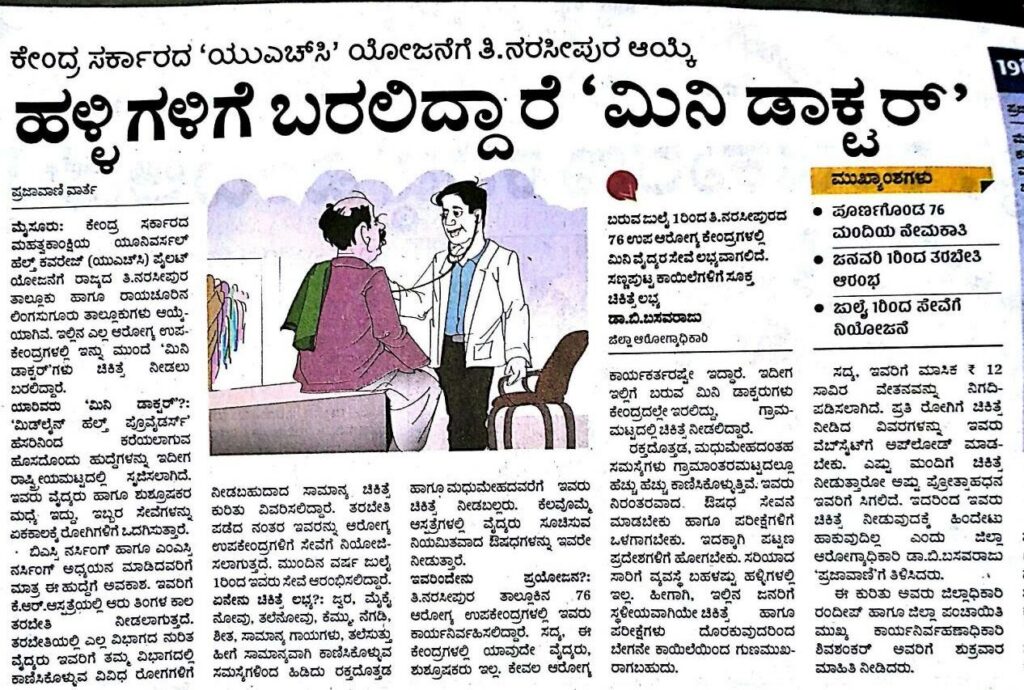
The Community Health Officer (CHO) cadre, created under the vision of strengthening rural healthcare delivery through trained nursing professionals, is increasingly facing role dilution and administrative misutilisation, according to the Akhila Karnataka State Community Health NHM Contractual Employees Union.
State President Mamit Gaikwad stated that the present deployment pattern of CHOs in several districts has deviated from the original purpose for which the cadre was established under the Universal Health Coverage (UHC) initiative and later expanded through Ayushman Bharat and Health & Wellness Centres (HWCs).
CHO Cadre Was Created for Rural Primary Healthcare:
According to the Union, the Community Health Officer cadre was specifically designed to strengthen Comprehensive Primary Health Care (CPHC) at village and sub-centre level through professionally trained nursing graduates.
Initially recruited under the Mid Level Health Provider framework, these professionals were designated as Community Health Officers after completion of the Bridge Programme in Community Health.
The Union stated that the original objective of the CHO system included delivery of all 12 Service Packages under Comprehensive Primary Health Care (CPHC), including:
- management of common illnesses,
- screening and follow-up of non-communicable diseases,
- preventive and promotive healthcare,
- protocol-based treatment,
- medicine dispensing,
- health counselling,
- maternal and child healthcare support,
- mental health services,
- elderly and palliative care support,
- and community-level healthcare delivery at Health & Wellness Centres.
The Union further stated that the CHO cadre was created as a specialised rural healthcare service model and not as a replacement workforce for shortages in unrelated categories or miscellaneous departmental duties.
“CHOs Are Being Diverted from Their Core Healthcare Role”
State President Mamit Gaikwad expressed concern that many CHOs are presently being assigned duties unrelated to their professional healthcare role, including:
- excessive clerical work,
- non-clinical data entry,
- survey activities unrelated to CPHC,
- deputation to compensate for staff shortages in other categories,
- and miscellaneous programme implementation responsibilities.
He stated that such deputation weakens the functioning of Health & Wellness Centres and adversely affects the quality of rural healthcare services intended under the national healthcare framework.
Concern Over Cadre Mismatch:
The Union further pointed out that CHOs are recruited mainly from:
- B.Sc Nursing,
- Post Basic B.Sc Nursing,
and other professionally trained nursing backgrounds with specialised community health training.
Despite possessing graduate-level healthcare qualifications and bridge training intended for primary clinical and public health services, many CHOs are allegedly being utilised in a manner inconsistent with their professional competency and original cadre purpose.
The Union stated that this has created a serious cadre mismatch between:
- professional qualification, and
- actual nature of duties assigned.
Government Investment in CHO Training and Professional Utilisation:
The Union also highlighted that the Government has made substantial investment in developing the Community Health Officer workforce through specialised training programmes. According to the Union, approximately ₹4–5 lakh per CHO is spent specifically on:
- residential training,
- Bridge Programme in Community Health,
- clinical skill development,
- practical public health training,
- mentoring,
- training materials,
- assessments,
- and competency-based capacity building.
The Union clarified that this estimated expenditure relates only to the training and professional preparation of CHOs, while infrastructure expenses, digital health systems, Health & Wellness Centre establishment, logistics, and other administrative expenditures are separate investments made by the Government.
Despite this significant investment in specialised healthcare training, the Union alleged that many CHOs are not being fully utilised for the primary healthcare and community health responsibilities for which they were trained.
Demand for Role Protection and Separate Cadre Recognition:
The Union has demanded:
- separate CHO cadre recognition,
- defined service structure,
- protection from arbitrary deputation,
- proper utilisation of healthcare skills,
- prevention of diversion to unrelated duties,
- and strengthening of Health & Wellness Centre-based services.
Mamit Gaikwad stated that the Community Health Officer system was introduced as a transformative rural healthcare initiative and should not be reduced to a miscellaneous administrative workforce or substitute arrangement for staff shortages in other categories.
He emphasised that protecting the original vision of the CHO cadre is essential both for safeguarding the professional dignity of CHOs and for ensuring accessible and effective healthcare services to rural communities across Karnataka.
Yes sir what you said absolutely true Karnataka government not filling other cadre staff posts and and not promoting CHO cadre in Karnataka